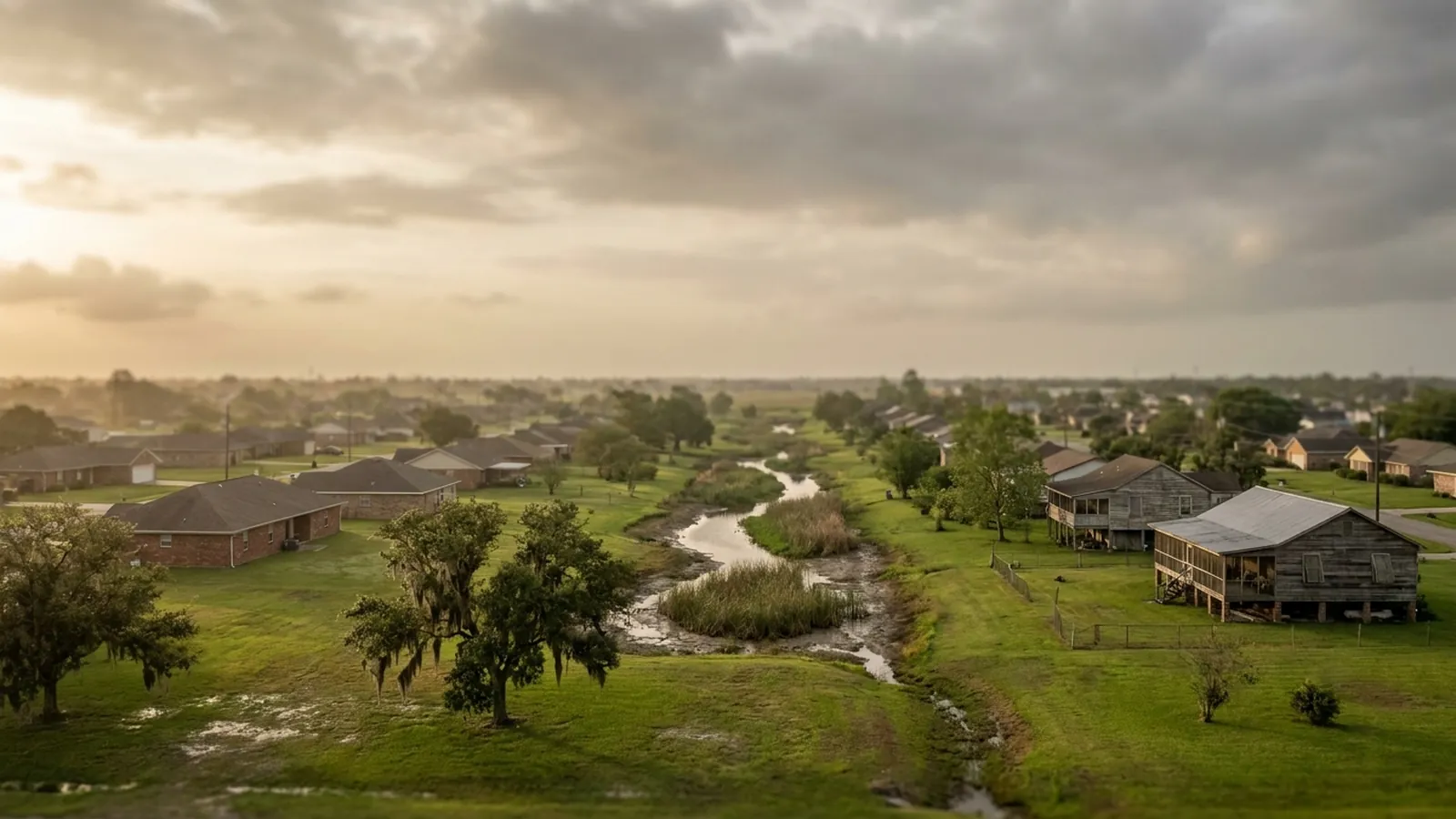
Water stands in Lafayette yards because permeability drops thirteenfold at about 14 inches — from 2.82 to 0.21 in the USDA record for Crowley silt loam. Rain soaks into the silty top and perches. That saturated bearing soil is what drives local foundation repair.
What is actually under your grass, why flat terrain makes it worse, and how to tell what you have without hiring anybody.
Two soils stacked on top of each other
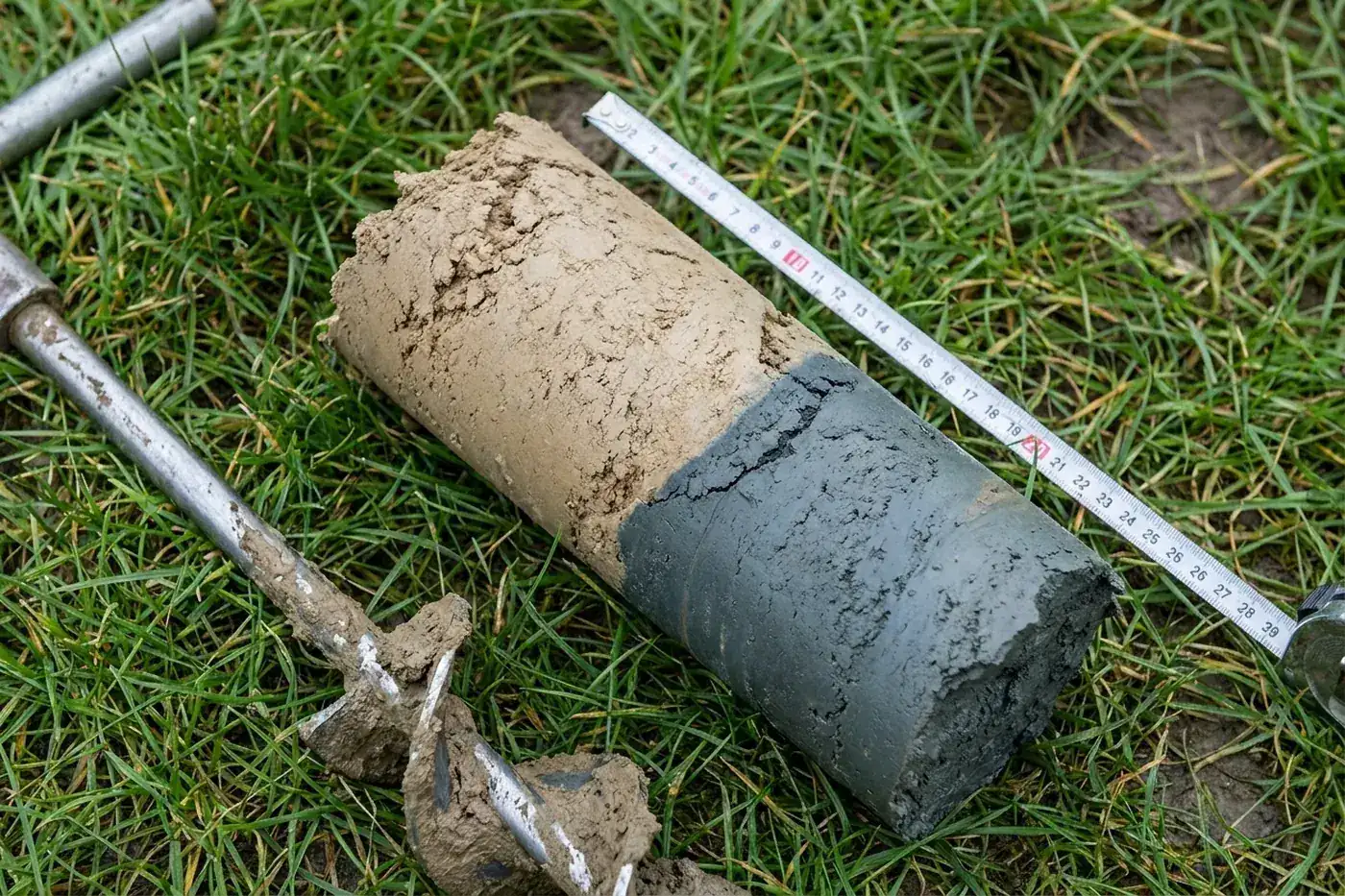
Dig a hole on the Lafayette prairie and you go through two quite different materials. The top is pale, silty and loose. Somewhere around a foot down it turns grey, heavy and dense, and the shovel stops being fun.
That is not a local peculiarity of your yard — it is the defining feature of the soil the USDA maps across most of this area. Crowley silt loam is classified as an Albaqualf, and the “alb” in that name refers to exactly this: a bleached, leached upper layer sitting on an abrupt change to dense clay beneath.
| Depth | What it is | Permeability |
|---|---|---|
| 0–7 in | 18.6% clay, 59.1% silt — the loose pale stuff | 2.82 |
| 7–14 in | 26.2% clay — the transition | 0.40 |
| 14–33 in | 48.8% clay — the dense grey layer | 0.21 |
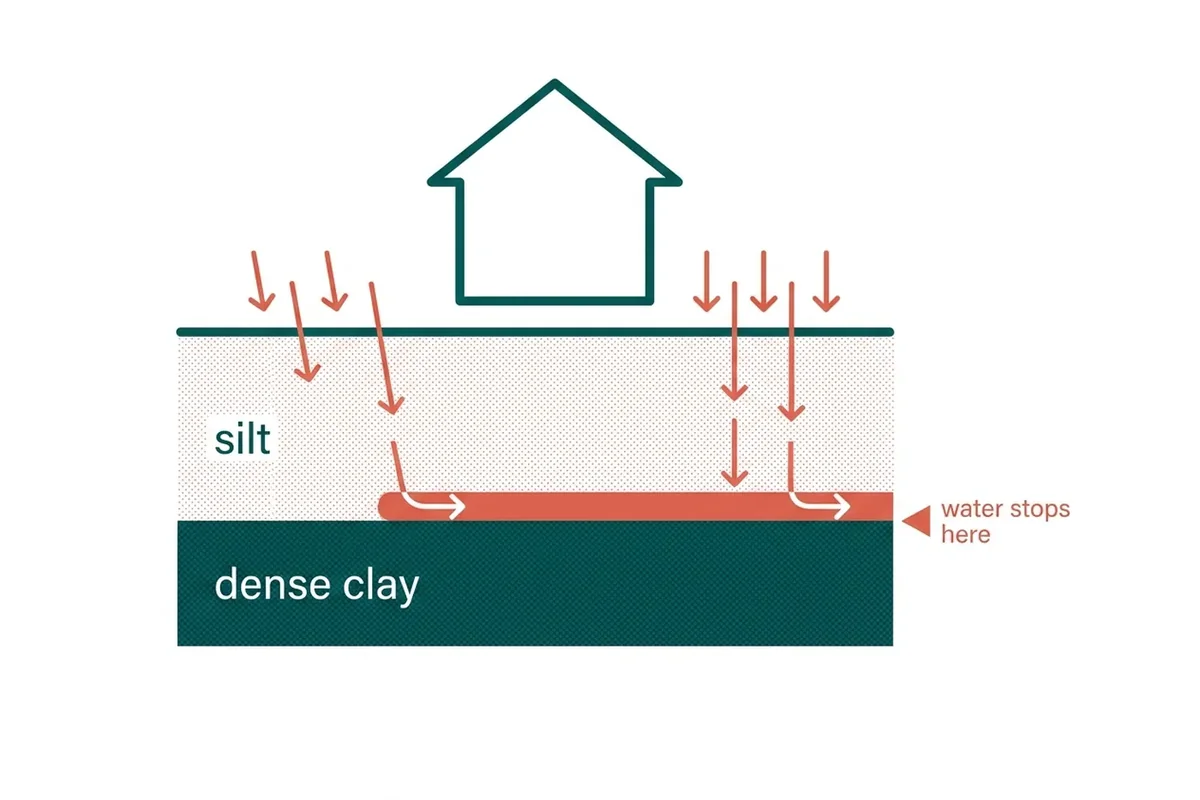
Water moves through the top layer roughly thirteen times more easily than through the one beneath it. So it goes in, arrives at the boundary, and effectively hits a floor.
And then it cannot go sideways either
On sloping ground, perched water eventually finds a way downhill through the upper layer. Acadiana does not offer much of that. The prairie is close to level, so the water sits roughly where it landed, in the layer your foundation is bearing on, until it evaporates or something drains it.
That is why the standing puddle in the low corner of the garden lasts for days rather than hours, and why it comes back every single time.
What it does to a house, and why it becomes foundation repair
Saturated soil supports less weight than the same soil drained. When the bearing layer under one part of a foundation stays wet for weeks, it compresses under the load in a way the drier ground a few metres away does not.
The house then settles unevenly — and uneven is the whole problem, because a structure can tolerate going down as a unit far better than it can tolerate one corner going down alone. Cracks, sticking doors and sloping floors follow from the differential, not from the wetness as such.
Find out for yourself, roughly
- After heavy rain, note where water stands and how many days it takes to go
- Dig or auger a hole about two feet deep somewhere away from the house and look at where the colour and texture change
- Fill it with water and see whether it drains in an hour or is still there tomorrow
- Do the same near the corner of the house that is giving you trouble, and compare
None of that is a substitute for measurement, but it will tell you within an afternoon whether you are dealing with the local mechanism or something else entirely. A good site visit does the same thing properly, with floor levels alongside it.
Standing water, answered plainly
Why does water stand in my yard for days?
Because it has nowhere to go. The prairie soil here is silty at the surface and dense below - the USDA records permeability falling from 2.82 to 0.21 across about fourteen inches. Rain soaks into the top, meets that layer, and stops. Flat ground means it cannot run off either.
Is that bad for the house or just annoying?
Both, and the second one matters more. Saturated soil carries less load than the same soil drained, so the ground under part of your foundation softens. Because the wetting is uneven, the settlement is uneven, and that is what damages a structure.
Will it dry out on its own eventually?
It does between wet spells, which is why the problem is seasonal rather than constant. What it does not do is stop happening. Every wet stretch puts the bearing soil back into the same condition, and the cumulative effect is what shows up in the house.
Can I fix it with topsoil and regrading?
Regrading helps with water running across the surface and does nothing about water that has already soaked in and perched. The two get confused constantly. If the problem is standing water days after rain, it is the second kind.
Does everyone in Lafayette have this?
Most of the prairie does. Ground nearer the Vermilion and along the coulees is alluvial and behaves differently. Ten minutes with a hand auger in your own yard settles which one you are on, so ask for it during the visit.
How is this different from Baton Rouge's clay problem?
Almost completely. Baton Rouge's Sharkey clay is 84 percent clay throughout with a linear extensibility of 19.8 - it swells and shrinks. Lafayette's Crowley silt loam measures 1 to 4 on that scale. Ours barely changes volume; it just cannot drain.
Book a Lafayette site visit
The single most useful thing you can tell us is what your yard does after heavy rain — whether water stands, for how long, and in which corner. On this ground that observation narrows the diagnosis further than any description of a crack. Say whether the house is raised or on a slab too. A local specialist serving Lafayette calls you back.