
Acadiana carries two housing stocks that fail differently, so the first answer below is which one you own. Raised pier-and-beam and post-war slab need different repairs, and a quote written for the wrong one is the common expensive mistake.
Things you can see from the yard
How much does foundation repair cost in Lafayette?
Complete underpinning runs $4,000-$15,000 with piers at $1,200-$3,000 each. Subsurface drainage is $1,500-$6,000, releveling $2,500-$9,000, timber repair $1,500-$8,000. Ask whether the site visit is charged.
Why does water stand in my yard for days?
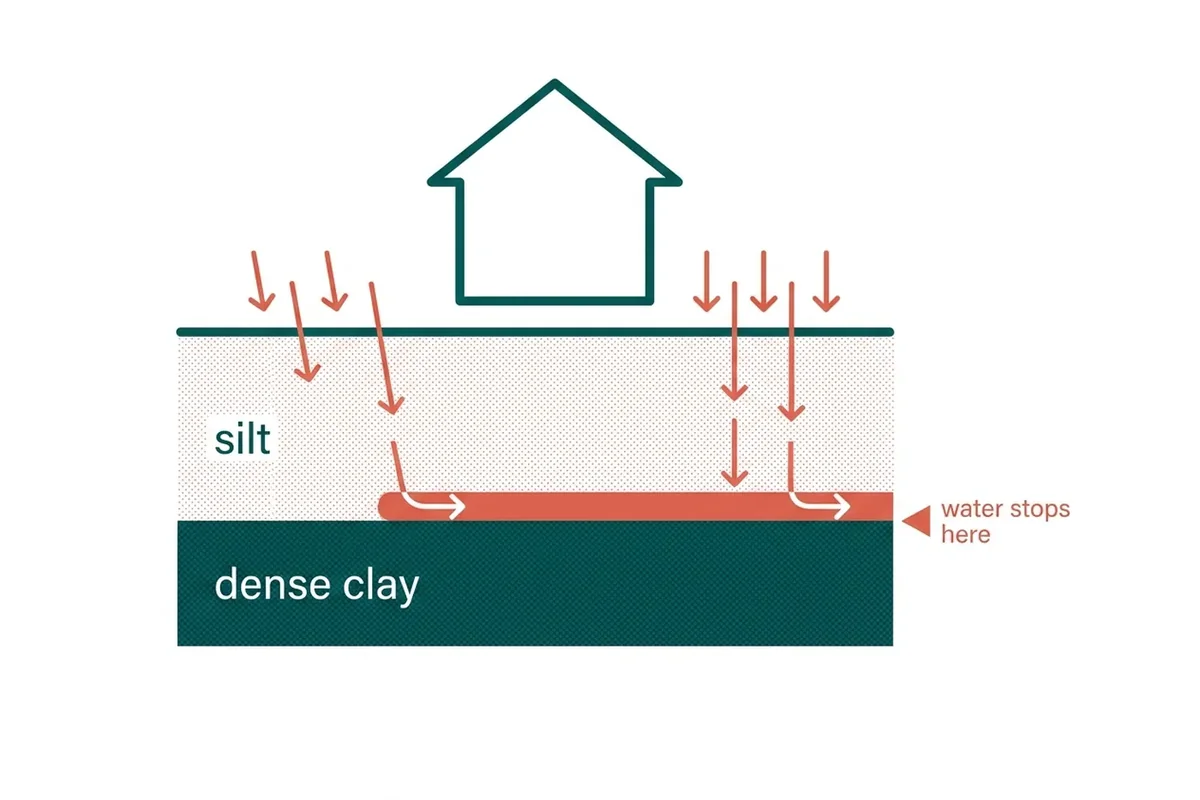
Because permeability drops thirteenfold at about fourteen inches - 2.82 falling to 0.21 in the USDA record for Crowley silt loam. Rain soaks into the silty top, meets that boundary, and stops. Flat ground means it cannot run off either.
Is standing water actually a foundation problem?
It is the local foundation problem. Saturated soil carries less load than the same soil drained, so the bearing layer under part of the house softens. Because the wetting is uneven the settlement is uneven, and uneven is what damages structures.
Should I regrade instead?
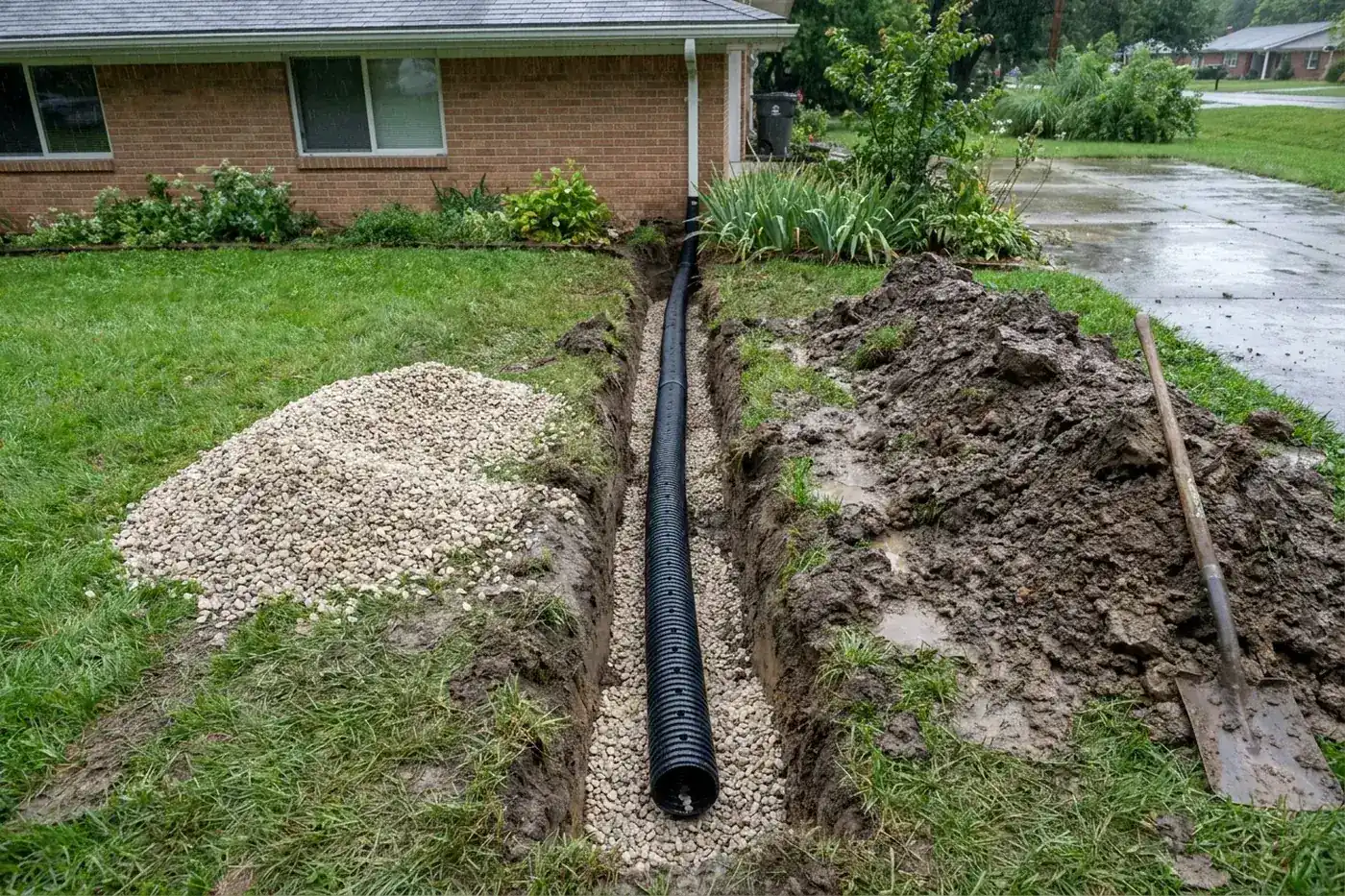
Regrading moves water running across the surface and does nothing for water that has already soaked in and perched. If the complaint is standing water days after rain, it is the second kind and grading will not reach it.
Things you can see from inside
Cracks and sticking doors - is that the foundation?
It might be, and how they are arranged tells you far more than that they exist. Doors all leaning one way with a steady tilt behind them reads as a slab that has gone over. Dips here and there, with doors disagreeing among themselves, reads as separate supports under a raised house.
My floor bounces. Is that serious?
It means you have a raised house and the floor structure has lost stiffness - supports settling, or timber that has deteriorated. It is worth looking at, and it is a completely different repair from anything a slab needs.
Is this the expansive clay everyone talks about?
Almost certainly not here. Crowley silt loam has a linear extensibility of 1 to 4 against Sharkey clay's 19.8 in East Baton Rouge Parish. Our dominant soil barely changes volume; it simply cannot drain.
How do I tell if my house is raised or slab?
Look at the back of the house where the wall meets the ground. A crawl space, vents at the base, or a step up with a void behind the skirting means raised. Concrete meeting the ground directly means slab.
Things nobody can see without digging or waiting
What is actually under my house?
Not knowable from the regional map, which describes areas rather than lots. A hand-augered hole shows the top two or three feet in ten minutes, and that is where this mechanism lives. Ask for one during the visit.
Is my house still moving?
A single appointment establishes the shape your house is in, not the direction it is heading. Knowing whether anything is still shifting means coming back for a second set of levels a few months on. Anyone confident about trend after one look has run past what they can actually see.
Will drainage definitely fix it?
It addresses the cause on the great majority of local houses. Whether it is sufficient on yours depends on whether the structure has already moved measurably, which the levels establish, and on whether the water is perched or a genuine high water table, which the auger establishes.
How deep will the piers go?
As far as it takes to reach steady resistance, and that shifts from one corner of a lot to the next. Which is exactly why a bid needs to name its assumption plus a per-section rate. One confident number covering an unmeasured depth has either been padded or will be revised.
Still deciding?
Nothing is charged for the first visit. Ask for the scope in writing and keep it, even when it says a drain is the whole answer. We have written up what happens on the day, plus how the two halves are priced and what is sitting under your grass.
Book a Lafayette site visit
The single most useful thing you can tell us is what your yard does after heavy rain — whether water stands, for how long, and in which corner. On this ground that observation narrows the diagnosis further than any description of a crack. Say whether the house is raised or on a slab too. A local specialist serving Lafayette calls you back.